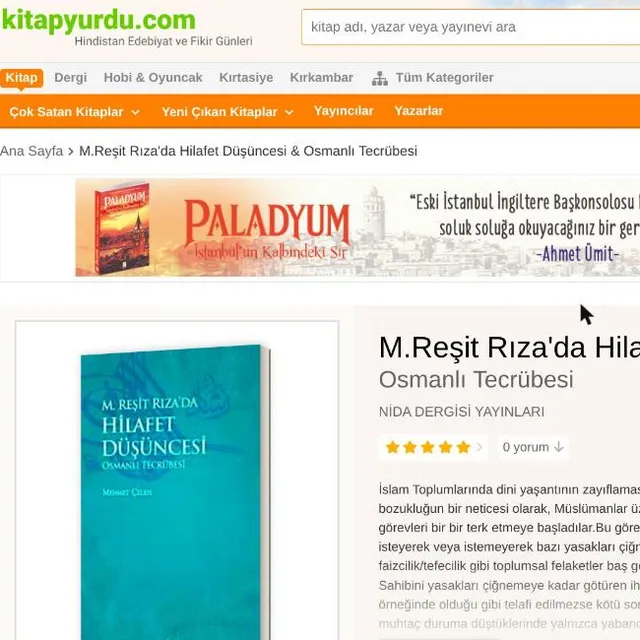
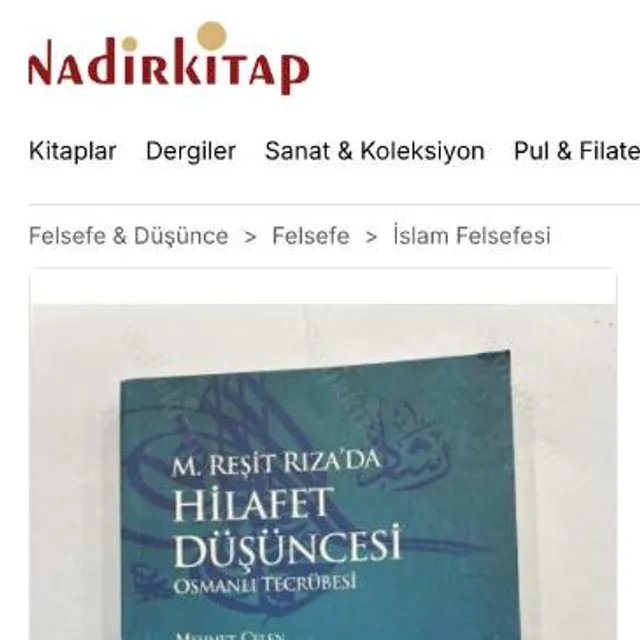
Book Introduction: The Idea of the Caliphate in M. Rashid Rida and the Ottoman Experience
About 6 min read
Read by an artificial voice. Arabic passages and footnotes are not read.
Translated from the Turkish original.Read the original
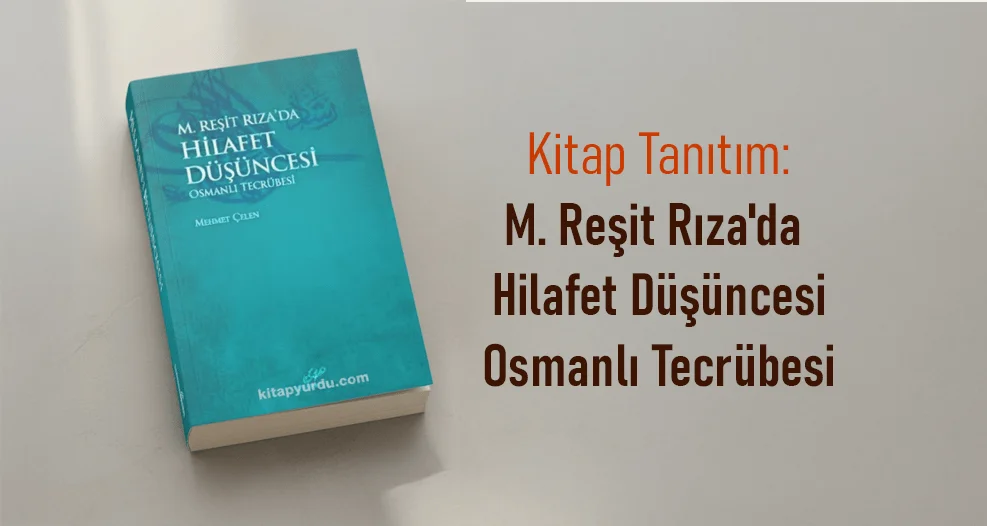
Date of publication of the book: 2008
Introduction:
"The Idea of the Caliphate in M. Rashid Rida: The Ottoman Experience" is a comprehensive study that sheds light on one of the most turbulent periods of modern Islamic thought and fills a serious gap in its field. This work, which places at its centre the views on the caliphate of Rashid Rida, who lived in the stormy setting of the end of the 19th and the beginning of the 20th century, carefully treats the Islamic lands under occupation, the dissolution in the Ottoman state and the modern understanding of the state that took shape in the same period.
Starting from the work al-Khilafa aw al-Imama al-'Uzma, which Rida wrote in 1922, the book examines in depth both his world of thought and his assessments of the Ottoman institution of the caliphate. With its structure of four chapters, the author sets out in a systematic way Rashid Rida's intellectual background, the socio-political conditions of the period, the solutions he proposed concerning the caliphate and his view of the Ottoman experience.
For those who are interested in history, politics and Islamic thought, this study is a valuable source both for understanding the period and for seeing Rashid Rida's broad horizon at first hand.
Preface:
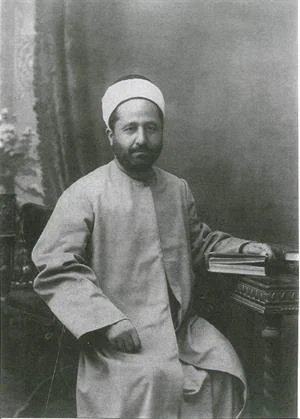
The assessments, ideas, understandings and experiences concerning the Ottoman caliphate, taking as a starting point the thoughts on the caliphate of Rashid Rida, the great thinker and scholar who came to maturity at the end of the 19th and the beginning of the 20th century, have not been the subject of serious research in our country. With the aim of filling this gap, even if only in part, we came to the conviction that it was necessary for us to carry out such a study. Starting from here, we took as our basis his work entitled "al-Khilafa aw al-Imama al-'Uzma", which Rashid Rida wrote in 1922 as an independent study and which was serialised in the journal al-Manar and then published as a book.
In the years when the work was written, the Islamic world had to a great extent been invaded by the Westerners. In most countries this invasion was carried on directly, and in very few countries through their own local allies. It will be necessary to take into account the author's state of mind, his psychological make-up and the great difficulty in which he found himself, in a setting where society was besieged and occupied in every field, social, economic, political, legal and moral, and where the collapse was continuing rapidly.
At that time the centre of the caliphate had been occupied, the government of the Grand National Assembly had been established in Ankara, the sultanate had been abolished and the caliphate had been turned into a spiritual office. While observing such a decline in the Ottoman state, our author presented to the public many applicable proposals in order to keep standing the caliphate, the centre and the support of the Islamic umma. These proposals were made to the Turks, first of all to the Ankara government, and to the Arabs. But what weighed more heavily was the idea that the Ottoman State should in any case be kept alive as a caliphate of necessity. According to him, only after this had been preserved could the establishment of the full and perfect caliphate become possible. However, it would be difficult for us to say that these proposals found a serious echo in the conditions of that day.
Between 1914 and 1924 Rashid Rida observed very rapid changes by living through them in person. The First World War and, after it, the occupation of all the Islamic lands, the abolition of the sultanate in 1922 and the turning of the caliphate into a spiritual form, and the abolition of the caliphate in 1924: all these were developments capable of causing a shock. In spite of all that happened and of these sudden situations, he did not stand idle, and he strove to deliver his proposals to all the Islamic lands by means of his journal "al-Manar". In this way he also gained international fame.
We have tried to treat our work in four chapters. In the first chapter we tried to give briefly the life and works of the author. In the second chapter we tried to describe, through Rashid Rida, the thought of Islamism, which became political especially after the 1850s, and modernisation, and the effects of the modern nation states on the Islamic world. In the meantime we examined Rashid Rida's thoughts and his sociological and political approach. We also tried to summarise Rida's convictions about the office of the caliphate, his ways of solution and his proposals, and to give our comments on this subject. In the third chapter we translated from the book he himself wrote the parts that concern the Ottoman caliphate. The whole of the work consists of 41 main headings. We, for our part, took into our work the main headings from 18 to 38, which are related to our subject, and the relevant parts of his article entitled "Khulasa" (Summary), which he published at the end. Since the first 17 sections contain the definition and the characteristics of the caliphate and what has been said on this subject, we did not find it necessary to include them in our work. Likewise, since the three main headings that follow examine different dimensions of the caliphate and do not contain the Ottoman experience, we did not consider it appropriate to translate them. We converted the Hijri dates that we determined in our translation into Gregorian dates by making use of Faik Reşit Unat's work entitled "Hicri Tarihleri Milâdi Tarihe Çevirme Kılavuzu" (Guide to Converting Hijri Dates into Gregorian Dates), as we have also stated in the bibliography. The fourth chapter forms the conclusion. Here we dwelt on how Rashid Rida's views can be assessed and on their problems.
In addition, at the end of our book we included as an appendix the introduction of Henri Laoust, who translated Rashid Rida's work into French and published it in 1938. We found this appropriate with the thought that it may give the reader an idea of how a Western writer assesses a Muslim scholar and Islamic values.
We consider it a debt to convey our most sincere thanks to our esteemed teacher Prof. Dr. İsmail Kara, who gave us his help to a great extent in the preparation of our work and in our studies.
Here I also thank my dear friend Mr M. Emin Çimendağ, who translated the great majority of Henri Laoust's introduction from French and brought it into Turkish, and the esteemed lawyer Ms Serap Yaşar, who did not withhold her contribution by kindly translating the last part of the same text, small though it is. I also convey my thanks to my dear friend the pedagogue Mr Muhammed Öztabak and to the esteemed Turkologist Ms Selma Uzunoğlu, who edited and proofread the book with great devotion.
I also thank my dear brother Mr Selçuk Ertargin and my esteemed elder brother Mustafa Çelen, who put great effort and contribution into the layout of the book.
We hope that our study, small though it is, will form a step in its field for those who are interested…
Mehmet Çelen – 2008
TopicsPolitics and the Caliphate