Competence to Write a Meâl of the Qur'an and the Conditions for Its Publication
About 27 min read
Translated from the Turkish original.Read the original
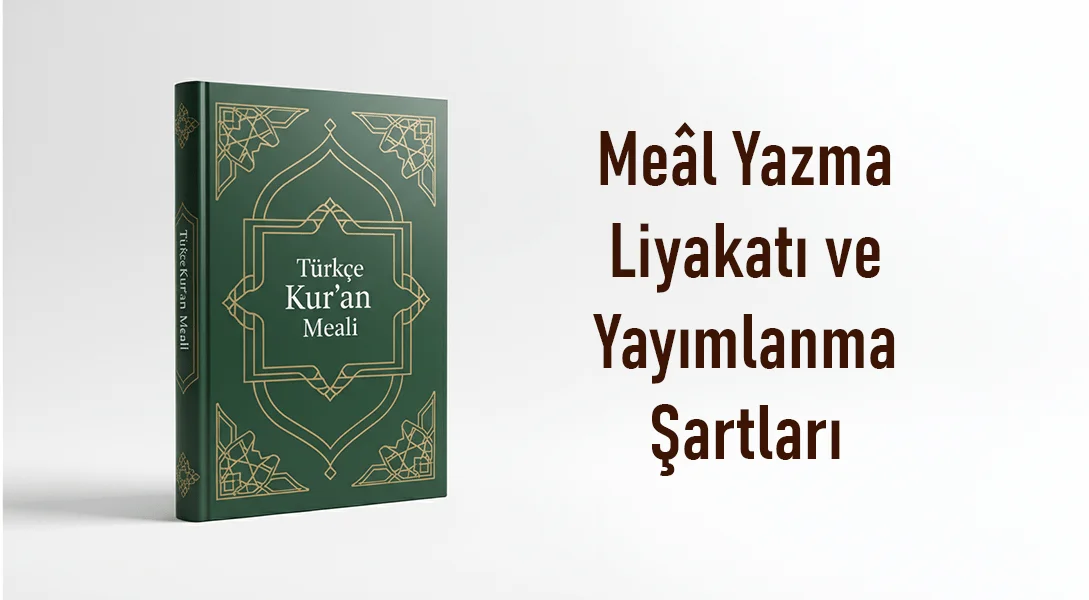
This paper was presented online on 13 October 2023 at the "International Symposium on Renderings of the Meaning of the Qur'an (Meâl): Problems and Proposed Solutions", organised jointly by the Faculty of Islamic Sciences of Muş Alparslan University and the Foundation for Research in Islamic Sciences (İSAV) on 13, 14 and 15 October 2023.
ABSTRACT
Islam is the name of the one religion sent by Almighty Allah; it is universal, and its last book is the Noble Qur'an. The Noble Qur'an was sent down in Arabic to the last prophet, Muhammad (peace and blessings be upon him), because both the Prophet and the society in which he lived spoke the Arabic language. The purpose for which the Book was sent to people was that it be understood and applied in their lives. The Qur'an was revealed 1413 years ago by the Gregorian calendar in order to be understood and made clear, and its aim towards that same purpose continues today. For this reason it needs to be translated into every language so that people and societies may understand it well.
Of course the translation of the Noble Qur'an is not like that of other books. It is a divine book with features of its own. For that reason a translation by just anyone who knows the Arabic language is not appropriate, for there is a very fine nuance between a translation (tercüme) and a meâl, a rendering of the meaning. Translation is to carry over and turn one language into another, whereas meâl is to determine, beside the meaning and the concept, the outcome that emerges. It is to turn, with the outcome that emerges, towards the meaning intended, to try to find it and to bring the meaning back to its original. In sum, it is to set out correctly the meaning of the divine speech in another language.
For this reason, to be able to translate the Noble Qur'an a person must possess the qualities we list below. He must be a person who:
- has full command of the Arabic language and literature and of its rhetoric (balagha),
- is well versed in the sciences of the Qur'an,
- has a share in the basic Islamic sciences (creed, tafsir, hadith, fiqh),
- knows well the literature of the language of the text together with the literature of the language of translation.
For these reasons there are very important differences between a meâl and a translation. A person must have competence in the sciences concerned so that the meâl produced accords with the divine intent. When publishing these divine books, too, certain conditions must be observed so as to leave no room for errors.
In our opinion it is most fitting that the conditions of publication be as follows:
- that the meâl be made in such a way that its equivalent in the second language is correct,
- that its editing and proofreading be very good,
- that the printing houses in which the meâl of the Qur'an is printed have the experience to do this work and that their staff be careful,
- that the Arabic part not be published in the script of the language of the meâl but be published in Arabic exactly as it is,
- obtaining approval for publication from a scholarly commission of at least five people,
- the approval of the meâl commission, and freedom of the press and of thought.
Keywords (5 words): Meâl, Arabic, Qur'an, Translation, Islamic Sciences
A- COMPETENCE TO WRITE A MEÂL
The Noble Qur'an is the last divine book, sent in Arabic. This divine book was sent down in stages over 23 years to the last prophet, Muhammad (peace and blessings be upon him). Thirteen of those years of revelation were in Mecca and the remaining ten in Medina. The Noble Qur'an was brought together in the period of the rule and caliphate of Abu Bakr (may Allah be pleased with him) by the commission headed by Zayd ibn Thabit and took the name Mushaf. The same Mushaf was copied in the period of the rule and caliphate of 'Uthman (may Allah be pleased with him), between the years 646 and 651 CE, by a commission headed by Zayd ibn Thabit and made up of 'Abd Allah ibn al-Zubayr, Sa'id ibn al-'As and 'Abd al-Rahman ibn al-Harith. One copy was left in Medina and the remaining copies were sent to the famous cities of Islam: Mecca, Kufa, Basra, Damascus, Yemen and Bahrain. These cities were the centres of Islam at that time. In that period, too, the lands of Islam were growing wider day by day, and societies that did not know Arabic were becoming adherents of the religion of Islam. Naturally, for these societies it was very important to understand the book of the religion in which they believed. In time these societies would feel the need to understand the Noble Qur'an in their own languages, and thus meâls would begin to be written.
Of course the meâls were not tafsir. Tafsir was a different branch of knowledge. Again, there is a very fine nuance between translation and meâl. Translation is to carry over and turn one language into another, whereas meâl is to determine, beside the meaning and the concept, the outcome that emerges. It is to turn, with the outcome that emerges, towards the meaning intended, to try to find it and to bring the meaning back to its original. In sum, it is to set out correctly the meaning of the divine speech and intent in another language. For this reason writing a meâl is not like translating, and certain conditions must be present, or come to be present, in the person who writes it. The most fitting thing is that those who do not meet these conditions should not write a meâl. At the same time a meâl must be published with certain conditions being observed.
In this study we shall try to examine thoroughly two matters, the writing of a meâl and its publication. Truly, the fact that the Noble Qur'an is a divine book requires greater care and meticulousness with regard to it. The Noble Qur'an was sent down in Arabic, in the language of the prophet to whom it came. On this there is agreement.
"We have sent it down as an Arabic Qur'an so that you may understand."1
"Thus have We sent it down as a judgment in Arabic."2
"Had We made it a Qur'an in a foreign tongue, they would have said: 'Why have its verses not been set out clearly? What, a foreign tongue and an Arab?'"3
As can be seen, the last book, the Noble Qur'an, was sent down in Arabic to a prophet and a society that spoke Arabic. For this reason its translation into other languages, or the rendering of its meaning, is important from this point of view. Indeed this arose from a sociological and psychological reality. As a result of the widening of the lands of Islam through the conquests and of societies that did not know Arabic becoming Muslim, the phenomenon of meâl and translation came about within the framework of efforts to understand the Book. Thus we state the conditions that must be found in the person who is to write a meâl as follows. He must be a person who:
- has full command of the Arabic language and literature and of its rhetoric,
- is well versed in the sciences of the Qur'an,
- has a share in the basic Islamic sciences (creed, tafsir, hadith, fiqh),
- knows very well the language into which the meâl is made, together with its literature.
It will be fitting to dwell on these conditions in detail.
1- Command of the Arabic Language and Literature and of Its Rhetoric
The writer of a meâl must know Arabic well and must understand and grasp the subtleties of the language in detail. The Arabic language is acquired by possessing the sciences of sarf (morphology), nahw (syntax) and balagha (rhetoric). The sciences of sarf and nahw make up the grammar of Arabic. Sarf takes as its subject the knowledge of the word, that is, the lexicon, and nahw the knowledge of the sentence. Knowing the structure of the word and of the sentence well gives a person the competence to be aware of all the subtleties that occur in the Noble Qur'an. Ibn Khaldun says the following about nahw: "The most important among them is nahw. For the basic aims intended in sentences come to light only through this science. Were it not for nahw, the elements of the sentence and the fabric of meaning of the expression could not be well grasped."4
In Arabic the science that concerns literary subtleties and arts is called balagha. This branch of knowledge studies the methods and principles of speaking correctly and aptly.5 As sub-disciplines, balagha is divided into three branches of knowledge: badi', bayan and ma'ani.
Badi': the branch of knowledge that studies the methods and rules by which an expression woven with literary arts is flawless in wording, reasonable in meaning and at the same time possessed of harmony.6 This science is divided into two, the arts that concern wording and the arts that concern meaning, and it beautifies the wording by adorning it.
In his work, Ibn al-Mu'tazz uses the term "badi'" for five elements which he identifies under these names: using a word in a figurative sense, "isti'ara"; using one word in two meanings, "jinas"; using two words of opposite meaning, "mutabaqa"; using the word at the end of an utterance or a line of verse at its beginning as well, "radd al-'ajuz 'ala al-sadr"; and bringing proof for what is said with the aim of securing eloquence, "al-madhhab al-kalami".7
Al-Jurjani, for his part, in his work Asrar al-Balagha, takes the concept of badi' in its general sense and states that main subjects such as jinas, tibaq, tawshih, radd al-'ajuz 'ala al-sadr and isti'ara are divisions of badi'.8
Bayan: the scholarly discipline that deals with conveying a meaning by different styles and ways whose indication is clear.9
Ma'ani: the science that puts under the lens the states and conditions of the wording that suits what the situation requires.10 It is the branch of knowledge that studies the conditions for speech to be apt and the principles of adapting speech to the situation and the place.
According to Ibn Khaldun, the sciences that concern the Arabic language are divided into four. These are lexicon (lugha), nahw, bayan (balagha) and literature (poetry), and they are sciences that must be known, especially by the scholars of fiqh.11
We too say that, for a divine and sacred book such as the Noble Qur'an to be translated into another language or for its meaning to be rendered, the sciences of the lexicon, nahw and balagha of Arabic must be known. To turn to such a task without knowing them, or with half knowledge, can lead to very great errors. For example, the word "fa'iz", which occurs in the Qur'an and expresses the meaning of salvation, is translated in the sense that faiz (interest) has in present-day Turkish.
2- Being Well Versed in the Qur'anic Sciences
Although these branches of knowledge became independent later, they have had a great share in giving meaning to the Noble Qur'an and in its being understood. In this field subjects such as the revelation of the Qur'an, its arrangement, its collection, its writing down, its recitation (qira'a), its tafsir, its inimitability (i'jaz), its abrogating and abrogated verses, and its language, style and rhetoric have been mentioned.12 From this point of view it is very important to know these sciences.
Let us consider the question: "How can the science of tafsir contribute to someone who writes a meâl?" From the first century to the present day thousands of works of tafsir have been written. In them it is always possible to find explanations13 of the words, concepts and terms, and even of the sentences, that occur in the Qur'an. How the Qur'an was revealed and what the Arabic expressions of the period of revelation meant can be learned from these books of tafsir. Such knowledge makes it possible to reach a truer meaning when giving the meâl.
The arrangement of the Qur'an is in general as it is in the Mushaf of 'Uthman (may Allah be pleased with him). In recent times, however, an arrangement according to the order of revelation has been made. This arrangement too is an important feature to which attention must be paid when a meâl is written.
Asbab al-nuzul is a branch of knowledge that explains the occasions on which the verses of the Qur'an were revealed. When one is trying to understand the verses and when meaning is given to them, the occasions of revelation too serve as a guide and an explanation and are a support for understanding the verse better.
The science of qira'at sets out the differences and the rules concerning the manner in which the verses and the words are read. The meanings given to words, which take shape according to the reading of the scholars of qira'at, sometimes show changes. When a meâl is written, attention must be paid to these changes as well.
An important matter concerning qira'at is that of the modes (wujuh). As for a reading's agreeing with the Arabic language, even if in one mode: provided that it meets the other two conditions, if a reading agrees with the dialect of any one of the Arab tribes or with any one of the modes of nahw, it has been accepted as sound, whether it be eloquent or most eloquent, and whether it be of the kind agreed upon or disputed.14
3- Having a Share in the Basic Islamic Sciences (Creed, Tafsir, Hadith, Fiqh)
When we say "having a share in the basic Islamic sciences", what is meant is having an understanding of these fields. The real source of these sciences is the Noble Qur'an, and knowing them will be a means of being sounder in words, concepts and terms and of giving the right meaning when the meâl is given.
The science of creed ('aqa'id) explains the principles of belief and forms the terminology relating to belief that occurs in the verses. The basic principles of the religion of Islam, the rulings in which it is necessary to believe, constitute the creed. The science that speaks of these basic principles has been called the science of 'aqa'id.15
An effort should be made to express the concepts relating to creed in the best way in the language into which the meâl is made. In this way no basic error will have been made on the point of the principles of belief.
We mentioned the science of tafsir when speaking of the sciences of the Qur'an.
The science of hadith is made up of the statements of our Prophet in word, in deed and in tacit approval16 and of methods. Many scholarly studies and secondary branches of knowledge have come into being in the field of the science of hadith.17 Knowing the sound ones among the reports that explain the verses, interpret them and show their application, in particular, will be of great help in the writing of a meâl.
Fiqh: the word fiqh, which in the dictionary means "to know a thing, to understand it well and fully, to grasp it in depth", carries a more particular meaning than other concepts of near meaning such as 'ilm (knowledge) and fahm (understanding).18 As for the science of fiqh, the presence in the Book of many subjects, of acts of worship ('ibadat), dealings between people (mu'amalat) and penalties ('uqubat), increases the importance of fiqh. Thus knowing fiqh will help in understanding correctly the many rulings contained in the verses and in expressing correctly the concepts and terms of fiqh. Usul al-fiqh too will help the writer of a meâl in this matter.
In conclusion, knowing these sciences will make it possible for more correct meanings and explanations to emerge in the writing of a meâl.

4- Knowing Well the Language into Which the Meâl Is Written, Together with Its Literature
The person who renders the meaning into another language must also know very well the language into which he translates, with its grammar and its literature. A person who does not know well the language into which he translates falls into many errors in the rules of the language, in literature and in terminology. And this means the greatest injustice done to a sacred book such as the Qur'an. Meâls prepared without attention to the points we have mentioned are recognised at once. For that reason, before embarking on the activity of writing a meâl a person must test himself well on this point. If the result of this test is positive, then he should decide to write.
B- WHAT ARE THE CONDITIONS FOR PUBLISHING A MEÂL?
When publishing these divine books, too, certain conditions must be observed so as to leave no room for errors. These conditions will be a means for the meâls that are to be published to be published in a more correct and fitting way. Five points have been determined in this matter, and it will be useful to give the necessary explanations about each of them.
1- Writing the Meâl in Such a Way That Its Equivalent in the Second Language Is Correct
It is very important that the meaning be given correctly in the language into which the meâl is translated and that the exact equivalent of the words be given. The sentences, the words and idioms and the literary terms must be expressed completely and identically in the language of translation. In addition, the meâl must be understandable, plain and clear in the language in which it is written. One must avoid complicated, tangled expressions that are hard to understand and take care that it reads fluently. Since some words will cause difficulty if they are translated exactly in their dictionary and literal meaning, it is more fitting that their equivalent in that language be expressed correctly.
2- Good Editing and Proofreading
Since the Noble Qur'an is a sacred book, it must be in perfect form when it is published. The construction and structure of the sentences must reflect exactly the features of the language of translation. The words must be written correctly, the rules of spelling must be followed, and the rules of orthography must be duly observed. The editing and proofreading must be done by an expert in that language.
3- Printing the Meâl at Experienced and Specialised Printing Houses
Printing houses have a very important place in the printing of books. When the book is a sacred book, their importance increases all the more. For that reason it is more fitting that meâls be printed at printing houses that are specialised or experienced. Indeed, when we say this for Turkey, Istanbul may be mentioned as the place where this work is done as a speciality. The staff of such printing houses must also be experienced and competent. It is like Beirut in Lebanon, Cairo in Egypt, Damascus in Syria and Medina in Saudi Arabia. When a person who writes a meâl in Turkey has the meâl he has prepared printed in a city outside Istanbul, where there is no printing house adequate in equipment and facilities, at a printing house without qualification or experience in the printing of meâls, it is an unavoidable fact that the pages of the meâl will be mixed up, the page layout will be spoiled and the printing will be bad. Therefore the preparer of a meâl must not overlook this matter, so that his material and moral efforts may not go to waste.
4- Publishing the Arabic Text in Arabic
Since the Noble Qur'an is an Arabic text, it is this text that constitutes the original of the Mushaf. Meâls and translations give not the original of the Noble Qur'an but its meaning. For this reason it is the original of the Qur'an that is recited in the prayer; it is not permissible to recite the meâl. In Turkey in particular, the Arabic text printed in the letters of present-day Turkish gives rise to many errors. For since present-day Turkish is made up of Latin letters, sounds that are three letters in Arabic are voiced with a single letter. For example, the letter "h" in Turkish is used as the equivalent of three letters in Arabic ("خ", "ه" and "ح"). It will be useful to show this by means of one verb: the verb "halaka" is written for the verb that means "to create: خلق". Yet this verb may equally mean "to shave: حلق", and it may also express the meaning "to destroy, to annihilate: هلك". As can be seen, the meaning "to create" does not come out. Thus, by means of a single verb, how many wrong meanings are given rise to.
5- Obtaining Approval for Publication from a Scholarly Commission of at Least Five People
It will be fitting to consider the question: "Why is a commission proposed for the examination of meâls?" We are of the opinion that, just as the examination of copies of the Mushaf is necessary, so it is necessary for meâls too. For the attempts of those who are not qualified and competent in this field to write meâls make it necessary that measures be taken and that the way to this be closed. What must be done for this to come about? Here several questions face us:
a- How will this commission be set up and of whom will it consist?
b- What will its number be?
c- How will decisions be taken?
d- Which basic Islamic sciences will be represented?
e- By which institution will it be organised?
It will be useful to explain these in order.
a- This commission must be set up from persons who are expert and competent in the branches of the basic Islamic sciences. The person who is to be a member must have at least a doctorate in the academic field, or must have completed a madrasa education, received his ijaza and specialised in his field. Here, the presence of a scholarly board coming both from the academy and from the civil sphere will bring many benefits to the commission. The formation of the commission in this way both strengthens the commission and increases its competence and its effectiveness.
b- Several proposals may be put forward on the number of the commission. A board of five, seven or nine people is suitable. In our opinion, however, a board of at least five people is sufficient. So that it may meet more practically and easily, there may be five full members and five substitute members.
c- It is also fitting to dwell on the question: "How should this commission take its decisions?" This too is a very important matter, because these decisions assess the effective and final position regarding the publication of a meâl. What is desired, of course, is that decisions be taken unanimously. But when this is not the case, they may be taken by a decision of a two-thirds (2/3) majority. However, in anomalous (shadhdh) cases whose meaning would affect society negatively or could cause outrage, it is most fitting to give a negative decision unanimously.
d- It is unavoidable that the basic Islamic sciences such as the Arabic language and its rhetoric, tafsir, fiqh and hadith be represented on this commission. Since the Noble Qur'an was sent down in Arabic, a member of the commission must of course know the Arabic language and its rhetoric very well. He will identify the errors that may occur in this respect and will help decisions to be taken accordingly. Since tafsir is the explanation, interpretation and ta'wil of the verses of the Qur'an, it too is necessary in the first degree. In view of the fact that many subjects concerning acts of worship, dealings and penalties are contained in the Book, the science of fiqh too is of very great importance. For this reason the presence of a member who is an expert in the science of fiqh is also essential. Again, as for the science of hadith, it is very important to know the way our Prophet interpreted the verses, the manner in which he applied them, and his ways of assessing matters in social, economic and political life. At this point the presence of a member who is an expert in the science of hadith is necessary in order to examine whether the principles found in the sound hadiths are reflected in the meâls as well. In this way the decisions taken by members who have specialised in these sciences will be sound and will find acceptance.
e- By which institution will such a commission be formed and organised? This varies from country to country. The position, conditions and circumstances of each Islamic country are different. But it is recommended that each country take sound decisions in this matter that will find acceptance in society and will not draw a negative reaction.
The institution we propose for Turkey is the Presidency of Religious Affairs (Diyanet İşleri Başkanlığı). There are dozens of faculties of theology and of Islamic sciences. But these faculties of ours do not in general occupy themselves with work of this kind. The Presidency of Religious Affairs, on the other hand, has for a long time been organising work of this kind and working actively. It examines and approves the copies of the Mushaf published in Turkey and has a special board for this. It also has a regulation on the criteria for the printing and publication of the Noble Qur'an.19 In addition, when requested, the High Board of Religious Affairs examines printed publications in accordance with Law no. 633, published on 22.06.1965. This is expressed in article 5, paragraph (e), of the same law as follows: "To give an opinion on printed, audio and visual works whose examination is requested."20 It is more fitting that the Presidency of Religious Affairs, an organisation that has such experience and addresses the whole of Turkey, be the institution that forms the commission and carries out its organisation. It has the equipment and the means to make this process applicable and sustainable.
6- The Approval of the Meâl Commission, and Freedom of the Press and of Thought
a- Freedom of the Press
We have tried to state, with its reasons, why the approval of a commission is necessary. It may be claimed that the approval of a written meâl by a commission before it is published is contrary to the freedom of the press. Let us try to reason about whether such a claim is possible or not.
It was stated that the Noble Qur'an is a divine book and, in this respect, sacred. There should be no right to dispose as one wishes of what is sacred and of a phenomenon that rests on the divine. For here you are not producing something in your own name. Of course translation is a production, but it is a production not in your own name but in the name of another. When this concerns a sacred book, greater care must be taken and conformity with the original must be observed. Otherwise the adherents who believe in that book may be offended and humiliated through their beliefs being trifled with, the fundamentals being changed and the true structure being corrupted. For this reason, with the purpose of protecting the freedom of religion and belief, the work done must be supervised and checked, and whether or not it conforms to the original must be established by competent boards.
In conclusion, the carrying out of this supervision is not contrary to the freedom of the press. It is directed to the purpose of protecting the freedom of religion and belief.
b- Freedom of Thought
It may be claimed that the approval of a written meâl by a commission before it is published is contrary to the freedom of thought as well. Here, of course, it will be fitting to consider what thought is.
A person's stating, expressing and spreading his own thought is of course considered within the scope of the freedom of thought. A meâl, however, is not a person's own thought. It is a divine message and thought. Therefore there is always an obligation to protect the original in what is sacred. When the meaning is rendered, there is of course the translator's own interpretation and understanding, but he must not move away from the fundamentals and from the basic content. Indeed, even when a person is stating his own thought it is not fitting for him to act as he wishes. For example, no one can slander a person, a group or a society and then say: I am stating my own thought. Even if it is said, this slander calls for punishment by the relevant courts. For this reason the existence of supervision in the writing of a meâl, the checking of whether or not the fundamentals of the sacred are observed, and the obtaining of approval in the end are not contrary to the freedom of thought.
BIBLIOGRAPHY
Birışık, Abdulhamit, "Kıraat", DİA, XXV, Ankara 2022.
idem, "Tefsir", DİA, XXXX, Ankara 2011.
idem, "Ulûmü’l-Kurân", DİA, XXXXII, Istanbul 2012.
el-Cürcânî, Abdülkahir, Esrârü’l-belâga (ed. H. Ritter), Istanbul 1954.
Çokyürür, Mehmet Zahit, İbn Haldun’un Belagât Kuramı; Necmettin Erbakan Üniversitesi İlahiyat Fakültesi Dergisi, no. 48, December 2019, p. 522.
Durmuş, İsmâil, "Meânî", DİA, XXVIII, Ankara 2003.
Hacımüftüoğlu, Nasrullah, "Beyân", DİA, VI, Ankara 1992.
idem, "Bedî", DİA, V, Istanbul 1992.
İbnü’l-Cezerî, en-Neşr fi’l-ḳırâʾâti’l-ʿaşr, Beirut 1985, I, 9-12.
İbn Haldûn, Ebû Zeyd Veliyyü’ddîn et-Tûnusî (d. 808/1406), Muḳaddimetu İbn Haldûn, ed. ‘Abdullah Muḥammed ed-Dervîş, 1st ed., Mektebetu’l Hidâye, Damascus, 1425/2004, II, p. 367.
İbnü’l-Mu‘tez, Kitabü’l-Bedîʿ (ed. I. Kračkovskij), London 1935.
Maṭlûb, Aḥmed, Mu‘cemu’l muṣṭalâḥâti’l-belâğıyye ve teṭavvürihâ, Maṭba‘atu’l Mecme‘ı’l-‘Ilmî el-‘Irâḳî, 1403/1983, I, 409.
Mekkî b. Ebû Tâlib, el-İbâne (ed. Muhyiddin Ramazan), Damascus 1399/1979.
Kandemir, M. Yaşar, "Hadis", XV, Istanbul 1997.
Karaman, Hayreddin, "Fıkıh", XIII, Istanbul 1996.
Ḳazvînî, Muhammed b. ‘Abdurraḥmân el-Haṭîb (d. 739/1338), Telhîṣu’l-miftâḥ, 1st ed., Mektebetu’l-Büşrâ, Karachi, Pakistan, 1431/2010.
Kılavuz, Ahmet Saim, "Akaid", DİA, II, Istanbul 1989.
Kılıç, Hulusi, "Belagat", DİA, V, Istanbul 1992.
Teftâzânî, Saadeddin, el-Muṭavvel şerḥu telhîṣı miftâḥı’l-‘ulûm, pp. 166-167.
Yaʽkûb, Emîl Bediʽ, el-Muʽcemu’l-mufaṣṣal fî’l-luğati ve’l-edeb, 1st ed., Dâru’l-‘İlm li’l-Melâyîn, Beirut, 1987, I, 329.
ez-Zürkānî, M. Abdülazîm, Menâhilü’l-ʿirfân, I, Cairo 1362/1943.
Internet:
https://www.mevzuat.gov.tr/MevzuatMetin/yonetmelik/7.5.39802.pdf
Footnotes
-
Yusuf, 12:2. ↩
-
al-Ra'd, 13:37. ↩
-
Fussilat, 41:44. ↩
-
İbn Haldûn, Ebû Zeyd Veliyyü’ddîn et-Tûnusî (d. 808/1406), Muḳaddimetu İbn Haldûn, ed. ‘Abdullah Muḥammed ed-Dervîş, 1st ed., Mektebetu’l Hidâye, Damascus, 1425/2004, II, p. 367. ↩
-
Yaʽkûb, Emîl Bediʽ, el-Muʽcemu’l-mufaṣṣal fî’l-luğati ve’l-edeb, 1st ed., Dâru’l-‘İlm li’l-Melâyîn, Beirut, 1987, I, 329; Hulusi Kılıç, "Belagat", DİA, V, Istanbul 1992, p. 380. ↩
-
Nasrullah Hacımüftüoğlu, "Bedî", DİA, V, Istanbul 1992, p. 320. ↩
-
İbnü’l-Mu‘tez, Kitâbü’l-Bedîʿ (ed. I. Kračkovskij), London 1935, p. 57; Nasrullah Hacımüftüoğlu, "Bedî", DİA, V, Istanbul 1992, p. 320. ↩
-
Abdülkahir el-Cürcânî, Esrârü’l-belâga (ed. H. Ritter), Istanbul 1954, pp. 20, 368, 370; Nasrullah Hacımüftüoğlu, "Bedî", DİA, V, Istanbul 1992, p. 320. ↩
-
Ḳazvînî, Muhammed b. ‘Abdurraḥmân el-Haṭîb (d. 739/1338), Telhîṣu’l-miftâḥ, 1st ed., Mektebetu’l-Büşrâ, Karachi, Pakistan, 1431/2010, p. 81; Maṭlûb, Aḥmed, Mu‘cemu’l muṣṭalâḥâti’l-belâğıyye ve teṭavvürihâ, Maṭba‘atu’l Mecme‘ı’l-‘Ilmî el-‘Irâḳî, 1403/1983, I, 409; Nasrullah Hacımüftüoğlu, "Beyân", DİA, VI, Ankara 1992, p. 22. ↩
-
Ḳazvînî, Telhîṣu’l-miftâḥ, p. 12; Teftâzânî, Saadeddin, el-Muṭavvel şerḥu telhîṣı miftâḥı’l-‘ulûm, pp. 166-167; İsmâil Durmuş, "Meânî", DİA, XXVIII, Ankara 2003, p. 204. ↩
-
Mehmet Zahit Çokyürür, İbn Haldun’un Belagât Kuramı; Necmettin Erbakan Üniversitesi İlahiyat Fakültesi Dergisi, no. 48, December 2019, p. 522. ↩
-
M. Abdülazîm ez-Zürkānî, Menâhilü’l-ʿirfân, Cairo 1362/1943, I, 27, 33-35; Abdulhamit Birışık, "Ulûmü’l-Kurân", DİA, XXXXII, Istanbul 2012, p. 132. ↩
-
See Abdulhamit Birışık, "Tefsir", DİA, XXXX, Ankara 2011, p. 290. ↩
-
Mekkî b. Ebû Tâlib, el-İbâne (ed. Muhyiddin Ramazan), Damascus 1399/1979, p. 39; İbnü’l-Cezerî, en-Neşr fi’l-ḳırâʾâti’l-ʿaşr, Beirut 1985, I, 9-12; Abdulhamit Birışık, "Kıraat", DİA, XXV, Ankara 2022, p. 425. ↩
-
Ahmet Saim Kılavuz, "Akaid", DİA, II, Istanbul 1989, p. 212. ↩
-
Ebu’l Bekâ, el-Külliyat, pp. 370, 470. ↩
-
M. Yaşar Kandemir, "Hadis", XV, Istanbul 1997, p. 27. ↩
-
Hayreddin Karaman, "Fıkıh", XIII, Istanbul 1996, p. 22. ↩
-
https://www.mevzuat.gov.tr/MevzuatMetin/yonetmelik/7.5.39802.pdf. ↩
-
https://hukukmusavirligi.diyanet.gov.tr/Documents/633%20say%C4%B1l%C4%B1%20Kanun%20(6002%20%C3%B6ncesi).pdf. ↩
TopicsQur'an and Translation