The Complete Works of Mehmet Said Çekmegil
About 21 min read
Read by an artificial voice. Arabic passages and footnotes are not read.
Translated from the Turkish original.Read the original
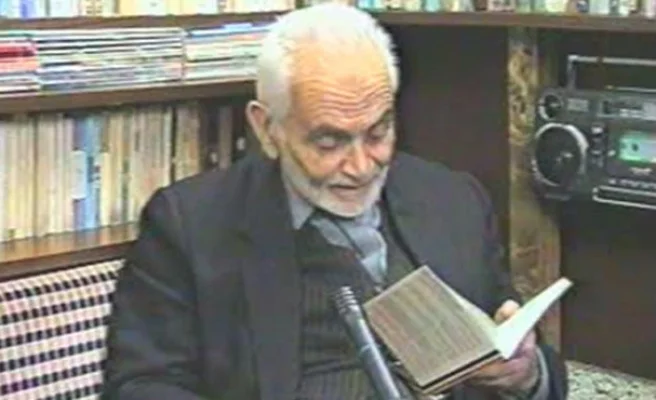
One of the distinguished thinkers and scholars of the Malatya circle of learning is our elder brother Mehmet Said Çekmegil. He lived a full life of about 84 years and opened a very important path in the field of knowledge and thought in Turkey. He spent his last two years in a severe illness and attained the mercy of the Truth in the Pendik district of Istanbul. He is now buried in the Şeyhli Cemetery in the Pendik district of Istanbul.
Said Çekmegil is a thinker who acted on his knowledge, with a personality that throughout his life, on the path of knowledge, directed people towards knowledge and reading, questioned and researched. Although his trade was tailoring and he did not graduate from any official school after primary school, he educated himself very well, gave lectures in many fields, continued the work of writing books that he began in 1947, and wrote 33 books in the course of his life, which come to about 4000 pages. Five of them are poetry, one is a play and twenty-seven are works of thought. He wrote his comprehensive works of research mostly after 1960. Thus, as Metin Önal Mengüşoğlu said, he fully earned the title of "the Wise Tailor".
The magazines and newspapers in which the writings and poems of Said Çekmegil were published are these: Büyük Doğu, Sebilürreşad, Ehli Sünnet, Türk Ruhu, Türk Düşüncesi, Serdengeçti, Toprak, Tohum, Ufuk, Hürsöz, Kriter, Oku, Bugün, Yeni İstiklal, Kitap Dergisi, Edebiyat Âlemi, Babıalide, Sabah, Hizmet, Türk Edebiyatı, Malatya’dan Ses, Vahdet, Haksöz, Panel, Nida, Umran.
In this article we have taken all the works of Çekmegil as our subject. From July 2004, the date of his death, to the present day we have not come across a study that treats all his works from the technical point of view and from that of their content and that speaks of all the books written about him. For that reason we saw the need for such a study. At the same time we have tried to show bibliographically, in the footnotes, the year and place of printing of the works, their publishers and how many pages they are.
To understand better the value of the works that Said Çekmegil wrote, it will be enough for us to glance at the 1950s and 1960s in Turkey and to look at the cultural work of that period and the works published in the name of religion. The number of works published in those years is very small. The works that existed were books in the manner of legends, such as Muhammediye, Kara Davut, Mızraklı İlmihal, Hz. Hamza’nın Kahramanlıkları, Hz. Ali’nin Cenkleri, Kesikbaş hikâyesi, Hayber Kalesi, Şahmeran and the like. Original studies are not often met with. Translation activities began from the middle of the 1960s, and that too ran at a very limited level.
The lecture that Çekmegil gave on "Our Understanding of Conscience", which began in Malatya in 1949, continued afterwards with fifteen lectures given in the same series in different cities until 1972. These lectures were published from the 1950s onwards as valuable works in the series "Our Understanding" (Anlayışımız).
Here we want to draw attention to one more important point. Said Çekmegil published the great majority of his works through Nabi-Nida Yayınları and Sanih Kütüphanesi Yayınları, the publishing houses that he himself founded and built up in Malatya. Thus he removed the risk of publishers not publishing his works out of commercial concerns. He himself dealt with both the typesetting and the printing of his books. In addition, his works were published by Pınar, Timaş, Kelime and İkbal publishers.
His works were published in four large cities, mostly in Malatya first of all, and in Istanbul, Ankara and Bursa.
Paying attention in general to the chronology of the dates of publication and placing the Anlayışımız series at the beginning, we have tried to give summary information about these works and to assess them.
The Anlayışımız ("Our Understanding") series:
-
İman Anlayışımız (Our Understanding of Faith). The first book of the Anlayışımız series is the work entitled İman Anlayışımız. This work examines in detail what faith is and who the believers are. Belief in the Hereafter, Paradise, Hell and the Heights (A'raf), the real test, the intellectual idolatry of modernity, mixing truth with falsehood and many subjects related to faith are treated in this book.
-
İnsanlık Anlayışımız (Our Understanding of Humanity). Master Çekmegil says the following in the preface to the first edition in 1958: "The trouble of today is not economic, as the materialists suppose, but a matter of ideals. The nations that give no place to thought and to noble feeling have been the cause of the disaster both of themselves and of humanity."
This work received the first prize in a competition held in Ankara.
In this work he took the human being as his subject, passed on the views of Western and Eastern philosophers about the human being, and tried to find an answer to the questions: where did I come from, why did I come and where shall I go? Subjects such as what humanity is and reason as the greatest book of the universe are treated in detail.
- Münevver Anlayışımız (Our Understanding of the Enlightened). This work is the lecture entitled "Who Is Called Enlightened", given on 04/02/1960 in Istanbul at the Association for the Struggle against Bad Habits, turned into a book. In addition, in the same year he gave a lecture in Istanbul at the Intellectuals' Club under the title "Our Understanding of Personality and What I Have Seen", and its summary also has its place in this work.
In this work matters such as reality, enlightenment, who is the enlightened person, who is the reactionary, the rotting seed, being a socialist and a Muslim at the same time, on Edison, speaking without knowing, on the call to prayer in Turkish, personality, the question of slavery and the tired world are treated very finely, in places in the form of dialogues.
-
Milliyet Anlayışımız (Our Understanding of Nationhood). It explains at length, with its documents, what true nationhood is, the nationalism that Almighty Allah wants. He strengthened the work with the ideas of sociologists on this subject. He criticised the nationalism that does not conform to the rulings of the Qur'an.
-
İktisat Anlayışımız (Our Understanding of Economics). The work begins with three hadiths: "He who is full while his neighbour is hungry is not a true believer.", "Give the worker his wage before his sweat has dried." and "Those who gather much wealth not for their eternity but for their passing worlds are base."
I think we shall not be exaggerating if we state that the work is the first original study in the field of Islamic economics in Turkey. In this work, after liberalism, materialism, socialism and capitalism have been examined, he passes to the field of Islamic economics. He examines Islam's view of the economy: the fundamentals of Islamic economics, insurance, zakat, interest, wastefulness, individual property, work, generosity, the question of work and the worker, and the question of slavery and concubinage.
- Siyaset Anlayışımız (Our Understanding of Politics). This book begins by answering the question "Why Did I Choose This Subject". In its first paragraph he says: "There is a saying, never checked, that has been grating on our ears for years: 'Religious people do not get involved in politics.' This European, or more correctly airy, view seems to have found a good many supporters as well; to flee from politics as one guards oneself against the devil, if it is not itself required by some policy, rests perhaps on the intention of turning a part of the long-suffering sons of Adam either into angels or into sheep, so as to bring them to a state in which they can be exploited. But it is not something that can be…"
"Politics is the name of the effort to secure the realisation of any aim, to seek and find the easy way of doing a thing, and to know the human being. To engage in politics without knowing people and without knowing how to manage them is likewise a hard task; it may even be said to be impossible."
In the work the politics of the Muslim, the importance of power, peace is better, domestic policy, legislation, power that rests on what is sound, giving rights the force of sanction, foreign policy, competence, administration based on consultation (shura) and many more subjects are treated. In the general framework the subjects of the sociology of politics, Islam and politics, and religion and politics are examined. We can call it the first book written on this subject by Muslim writers.
-
Ahlâk Anlayışımız (Our Understanding of Morals). It criticises the materialist conceptions of morals of the West and the form of them that has infected our Turkey. It also explains what good morals are and by which ways they are reached.
-
İbadet Anlayışımız (Our Understanding of Worship). This book explains, in a world public opinion in which acts of worship are counted as customs and customs as acts of worship, how all the conscious acts of the believer are honourable acts of worship, and that worship cannot be assigned to particular acts. It sets out, in the light of the noble Sunna, how every state of a believer turns into worship. A summary of this work has been translated into English.
The content of the book is very rich. The fundamentals are subjects such as faith, worship, fiqh, intention, jihad, prayer, zakat, fasting, pilgrimage and not doing what is forbidden. In addition, by way of ijtihad it divides politics: foreign policy into war, the call and armistice, and domestic policy into three, as justice, administration and education. It divides justice into the judiciary and punishment, and education into upbringing and teaching. In general the religion of Islam, dealings between people and the acts of worship are examined.
- Diyalektik Anlayışımız (Our Understanding of Dialectics). This work, by setting out the dialogue that has no criterion and the dialectics of measured and sound thought, shows that logical reasoning is peculiar to the Muslims.
It gives many dialogues under the headings: dialectics in the believer, the materialist theory and its criticism, can there be a synthesis in a correct thesis, and examples of measured dialectics. The book is made up to a great extent of flowing dialogues.
- İyi Niyet Anlayışımız (Our Understanding of Good Intention). This book tells what the postulate is in the intellectual believer, that taboos have no place in his life, how sound his criterion is, and that for unity and togetherness it is necessary to grasp the spirit of Islam and to have good intention.
In this work Çekmegil examined many subjects such as good intention and the understanding of Islam, Islam and politics, that deeds are according to intentions, can good intention prevent evil, public opinion, the measure of the Muslim, the intellectual Muslim, the human being and taboo, art and lies, and on unity.
His other works:
- Gizli Bir Ses Dedi Ki (A Hidden Voice Said). It is Çekmegil's first published book of poetry, sent to press in 1947.
In this work the poems are made up of couplets and quatrains. Ten poems are made up of quatrains and six poems of couplets.
-
Bir Nur Doğacak (A Light Will Be Born). This work too is a book of poetry by Çekmegil. "Striking and striking at the blind ignorant, the bigot, / at the soulless, / we shall tear down the idols, / we shall reach the light." Here the poems are written plainly and generally in free verse.
-
Ruhta İnkılap (Revolution in the Soul). This book of poetry had its second edition, with valuable essays of analysis about it, and that too is out of print.
This work is the first of the publications of Nur Kitabevi in Malatya and was published in 1950 as 34 pages.
- Müstesna (The Exception). This work begins with exceptions and says: "I have no enemy at all, praise be to Allah! Except the enemy of Islam. Thanks be to Allah, I have no friend at all either; except my believing brothers." In this book many more subjects are taken up, such as "let us get acquainted, the head and the Muslim, aphorisms, the feast day, the sacrifice, reason and feeling, knowledge and modesty, to the idolater, and the ideal".
In the general framework he dwelt on essays and on Islamic morals.
- İnsanoğlu Kendini Arıyor (The Son of Man Is Searching for Himself). This book is made up of the articles that appeared in their time in the scholarly journal called Ehl-i Sünnet in Istanbul and in the column of the Malatya Cultural Association Publications in the Fırat newspaper published in Malatya.
In addition, the text of the lecture on "Our Understanding of Religion and Philosophy", given at the Malatya Cultural Association, was added to the end of this work. In this work Çekmegil dwelt mostly on matters of creed and kalam.
- Limon Ağacım (My Lemon Tree). It is a small work by Çekmegil made up of 59 poems and three pieces of prose.
Although there are quatrains and couplets in this work, twenty-one poems are written in the free manner. Çekmegil, just like Mehmet Akif Ersoy, made the troubles of the Muslim society in which he lived his own trouble, and in his poems he offered social and individual solutions.
-
Servet Bey (Radyofonik Piyes) (Servet Bey, a Radio Play). It is a play written to be staged. This work, which the author wrote in 1955, could be published only ten years later. In the year it was written it was performed by high school students and was watched with appreciation.
-
Altın Anahtarlar (Golden Keys). It is a work of the kind known in the tradition of the science of hadith in Islamic history as "Arba'in / Forty Hadiths", in which the hadiths seen as important and suited to the conditions of each period are selected and made into a book. In this work Çekmegil too made a compilation of forty hadiths of the Messenger of Allah (peace and blessings be upon him) and formed a book. Writings and poems about our Prophet were also added to the book.
-
Sünnet-i Seniye/Yüce Yol (The Noble Sunna / The Exalted Way). In this book he examines in the light of revelation that the only way the Muslim is to follow is the noble Sunna, and that imitation, superstitions and lack of understanding do not befit the exalted way. He also dwelt on the matters of the method in understanding the Sunna and of how the hadiths should be viewed.
-
Aramızdaki Fark (The Difference between Us). It is one of Çekmegil's books of poetry.
-
İnsanın Yolu İslâm (The Way of the Human Being Is Islam). In this book he explains at length the fundamentals of Islam, the religion towards which human nature turns. It is very rich in content. Very important subjects are examined, such as: the way of the human being is Islam, what Islam is, the explanation of being a Muslim, the commands and prohibitions of the religion are laid down by the Lawgiver, intellectual effort, the obligation to search, fiqh, revelation, ijma' (the republic of learning), qiyas, custom and usage, reason and the disease of imitation. In the general framework it is made up of the religion of Islam, philosophy and various writings.
-
Tetkiklerde Metod ve Tenkid (Method and Criticism in Studies). This work was formed by bringing together the studies that were presented as seminars at the Malatya Thought Club and the Association for Competing in Good Works and published as articles in the magazine Kriter.
In content this book is made up of basic matters such as what criticism is, today's understanding of criticism, and can there be impartial criticism, together with general and particular criticisms. In this work he explains in detail that criticism is an act of worship.
-
İslâm’ı Yaşamak (Living Islam). The content of this book is very full. In this work, which draws attention to the main source, a critique of the unity of being (wahdat al-wujud) is made. The second part is given to the texts of three lectures on the subject delivered in Germany. In addition, beside important subjects such as intellectual stagnation, the light that appears, Islam above the ages, Islam above principles, and rights are determined by Islam, a few pieces written about the author are included.
-
Vahye Göre Büyük Zulüm (The Great Wrong According to Revelation). In this work Çekmegil tries to open up the answer to the question of what the greatest wrong is according to revelation and who the greatest wrongdoer is.
-
Âyetler Işığında Reçeteler (Prescriptions in the Light of the Verses). This book was formed by bringing together the relevant verses under many subject headings. The first prescription of the work, which is made up of 51 prescriptions in all, is "For beginning a permitted and halal task" and its last prescription is "For justice". The text of the lecture entitled "Tradition and Traditionalism through the Eyes of a Muslim", which Çekmegil gave on 6 January 1990 in Izmir at the National Youth Foundation, was also added to this book. In this work the study of the view of the verses was carried out by us.
-
Çağdışı (Out of the Age). In this work Çekmegil questioned the ages by asking questions such as: "Which age? The happy age of 14 centuries ago? May Almighty Allah make us among those who take that model age as an example. The 19th century, the age in which those troublemakers held the field? The age that, by pointing to injustices, overlooked those in the right, and that, by making humanity flounder in the dead ends of secularist philosophy, brought it down to today's dishonourable level; the age in which the materialists who made an idol of reason sprouted and grew tall in the swamps they called positive, the model age of those who made the earth a dungeon for humanity? The 20th century? The loathsome age that has stripped itself of modesty, that has become the slave of the technology it developed itself, in which evils of the English model are protected by laws?"
In content it includes very valuable subjects such as "the pagan world, the tired world, the society without a guardian, the human being and the others, the Messenger too is a human being, true and false words, our view of knowledge, a model for the hanif nation".
-
Müminde Hürriyet (Freedom in the Believer). This work examined the question of freedom very broadly. Among its subjects are the definition of freedom, the longing for freedom, the calls for freedom, freedom in the system of faith, freedom in Islamic society, the place from which freedom comes, the world of today and the like.
-
Dünya İslâm Devleti ve Prensipleri (The World Islamic State and Its Principles). The esteemed Hekimoğlu İsmail wrote a foreword to this work. In content many matters are examined, such as the world Islamic state, the sovereignty of the state, human systems, Islam or the Muslims, the basic principles, the humaneness of the principles, the homeland of the good, democracy and secularism.
In the general framework it dwells on the subjects of Islam and politics and of the Islamic call.
- Kur’ân’a Muhatap Olmak ve Engelleri (Being Addressed by the Qur'an and Its Obstacles). This book begins with the foreword of our esteemed teacher Prof. Dr. Yaşar Bağdatlı.
The content of the work dwells basically on how being addressed by the Qur'an comes about and what its obstacles are. Important matters are examined, such as understanding the Qur'an, is knowing Arabic enough for understanding, sound reason, the clear (muhkam) and the ambiguous (mutashabih) verses, the abrogating and the abrogated, the manner of looking at the Book, the statements of the Criterion and infallibility.
- Nâsih-Mensûh Masumiyet ve Recm (The Abrogating and the Abrogated, Infallibility and Stoning). The book begins with the foreword of the esteemed sociologist İbrahim Eroğlu.
In this work the subjects that form the title of the book are examined in detail and at length in the light of the Qur'an and the authentic Sunna.
- Yeni Dünya Düzeni İslâm’ın Gerçeği (The New World Order: The Truth of Islam). This work was published as a criticism of the book called İslâm Gerçeği, which was published in the first month of 1995 and prepared by six academics. In the preface he said of them: "In some places it carried classical airs, in some modernist and in some humanist. It called for criticism. In places these critiques too were being made."
In content it is made up of two parts, 'the new world order' and 'sentences from the truth of Islam'. The first part is made up of: is it the end of the modern age, a critique of Fukuyama, the view of Shevardnadze and the observations of Abd al-Rahman Munif. In the second part important subjects are examined, such as the truth of Islam, people who have not received the message, the conquest that opens the ways of happiness, lack of measure in criticising rulers, consent to evil is evil, can a human being be a proof against Islam, and the fashion of universality.
-
Bilginin Gücü (The Power of Knowledge). In its general framework this work speaks of science and philosophy.
-
Düşünceler Düşledim (I Dreamed Thoughts). In this book Çekmegil says: "My thoughts were the yield of the noble mind, the happy memory of the compassionate heart, the sweet fruit of my soul; it could not have enough of them. Their worlds had been turned into machines, their people for the most part into beasts, and the believers had been left as strangers. What was our human being to do? What should he do? Was there no remedy?"
Thinking, asking and questioning, he was looking for a remedy. It is a work that contains important subjects such as: we are thinking about our new world, the one who thinks is a verifier and the one who does not think is an imitator, the remedy that is thought of, let us think about ijtihad, I thought about the measure, let us think about democracy, let us think about the Ottomans, let us think about the universal. The whole of the book is given to thinking and to using the functions of reason.
Many articles, newspaper columns and poems have been published about Said Çekmegil. In addition, books have been written about him and a special issue has been brought out. On this occasion it will be fitting for us to give information about them as well.
Works written about him:
1- Çekmegil’in Eseri Neyi Anlatır (What Does the Work of Çekmegil Tell). This work was published while Çekmegil was alive. It became a book through the bringing together of more than 70 valuable pieces by 64 writers. This study gives the good news that right thinking too has begun to receive interest.
2- Büyük Doğu’nun Son Kalesi Said Çekmegil (Said Çekmegil, the Last Fortress of Büyük Doğu). It was written after the death of Çekmegil by our esteemed fellow townsman Şevket Başıbüyük. This work has been a fine biographical study that gives a detailed account of Said Çekmegil. In the appendices the pieces of esteemed personalities who speak about him were published, such as his son M. Selami Çekmegil, Abdullah Yıldız, Mehmet Alptekin, Metin Önal Mengüşoğlu, Ömer Şevki Hotar, Güven Akıncı, Bahaaddin Bilhan, Ramazan Keskin, Adil Akkoyunlu, Mehmet Çelen, Necip Cengil, Nabi Kürün and Hasan Begeç. This too added a fine flavour to the book and enriched it.
3- Said Çekmegil Özel Sayısı (Said Çekmegil Special Issue). In this special issue, arranged in memory of Master Çekmegil, the pieces of 44 writers in all were published and interviews were held. It has been a very fine and satisfying bouquet in which the pieces of writers from different quarters came together. Those who want to obtain ample information about Said Çekmegil can turn to this special issue brought out by the magazine Nida Dergisi.
4- Bilge Terzi Sait Çekmegil (The Wise Tailor Sait Çekmegil). M. Said Çekmegil, who treated the Muslims' problems of thought and understanding with a deep sense of study and responsibility, was a self-taught thinker with many qualities, a Muslim, a tailor, a writer and a publisher, on the way to the reawakening of Islamic thought at the centre of its basic sources.
With the Islamic work that he carried on in Malatya throughout his life, with the books he published, which aimed to be the voice of the movement of renewal that defended the return of Islamic thought to the sources, with the thought club he founded and with the conferences and seminars he attended at home and abroad, he tried to rebuild the damaged basic wholeness of the Muslims. According to him, an Islam without thought, without language, without concepts, without criticism and not resting on sound knowledge, a paralysed consciousness, could not be the fate of the Muslims. This study too was published as a work of biography.
In short, in this brief piece of research we have tried to give all the works of Çekmegil and the books written about him, together with their bibliographical details and a summary assessment.
TopicsPersonalities